


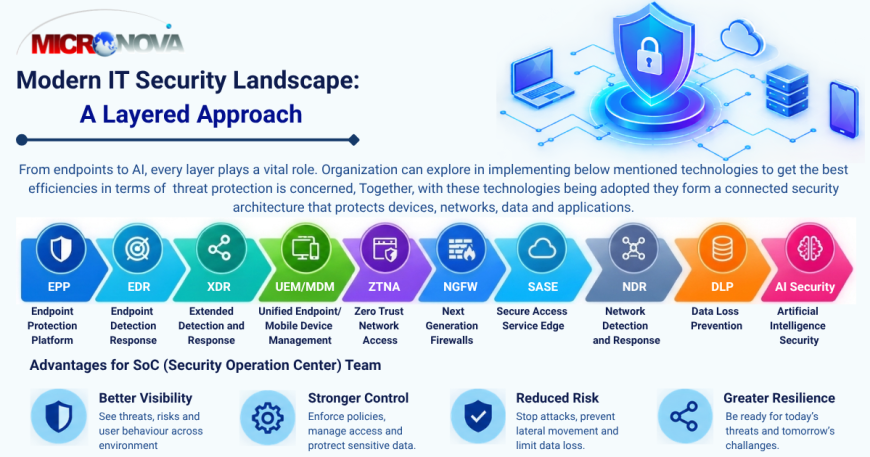
Cybersecurity is no longer a matter of securing a single office network or installing antivirus on employee computers. Users work from laptops and smartphones, applications run across cloud and on-premises environments, and employees connect from offices, homes and other locations.
The practical answer is not to collect more security products. It is to build a security architecture in which each layer addresses a specific part of the environment and provides useful context to the next layer.
This article follows that architecture from the device outward: endpoint protection, device management, application access, network gateways, distributed security, network behaviour and AI-aware security.
The guiding thread: secure the device → establish device posture → control application access → secure network traffic → extend protection across distributed environments → detect abnormal network behaviour → protect sensitive information.
Modern Security Architecture
A useful way to understand modern IT security is as a sequence of security decisions rather than a list of products:
Endpoint → Device Management → Application Access → Network/Gateway → Distributed Security → Network Behaviour → AI Security
Each layer answers a different question:
- What is happening on the device?
- Is the device managed and compliant?
- Who is requesting access and what application should they reach?
- Is the network traffic allowed and secure?
- Can security policies be consistently applied across remote users, branches and cloud environments?
- Does the network behaviour look normal?
- What happens to sensitive information when employees interact with modern applications and AI services?
That sequence starts at the endpoint because a secure access decision is difficult to make when the device itself is not under control.
For a detailed view of how these technologies work together to identify and mitigate threats, this article explores each layer of the modern security architecture and the role it plays in strengthening an organization’s overall security posture.
1. Endpoint Security, EPP, EDR, XDR & Endpoint DLP — Device Level
Endpoint security remains the starting point because laptops, desktops and servers are where users interact with business systems. Modern endpoint security has evolved beyond basic antivirus to provide prevention, detection, investigation and response capabilities.
Modern endpoint security asks a much bigger question:
“What is this device doing?”
This is where Endpoint Protection Platforms (EPP) have evolved toward Endpoint Detection and Response (EDR) and increasingly Extended Detection and Response (XDR).
Instead of investigating one suspicious file in isolation, security teams can examine the sequence of events.
For example:
Email attachment → document opened → script executed → credential access → external connection
A sequence like this provides considerably more context than a simple malware alert.
Where XDR Fits
XDR extends detection beyond an individual endpoint by correlating security signals across multiple layers of the environment.
Key capabilities include:
- Cross-Layer Threat Detection – Correlates security signals from endpoints, networks, identities, cloud environments and other integrated security sources.
- Threat Correlation & Analysis – Connects related alerts and events to identify attacks that may span multiple security layers.
- Incident Investigation – Provides broader context and visibility into attack activity and potential impact.
- Automated Detection & Response – Detects suspicious activity and can initiate predefined response actions where supported.
- Threat Hunting – Enables security teams to search collected telemetry for indicators of compromise and suspicious behaviour.
- Attack Chain Visibility – Helps trace activity across multiple stages of an attack to understand how an incident developed.
- Alert Prioritization – Correlates related security events to help reduce alert overload and focus attention on significant activity.
- Response Orchestration – Coordinates response actions across integrated security controls.
For example, if a workstation starts executing an unusual process while the same user account shows suspicious login activity and the device makes unexpected network connections, XDR can correlate these signals across security layers to identify a potentially coordinated attack.
But detecting activity across multiple security layers is only useful when the organization also knows whether the device itself is properly managed and compliant. That is where UEM/MDM becomes important.
Endpoint DLP
Endpoint DLP is another capability that operates directly on laptops and desktops to protect sensitive business information.
It can help identify and control how sensitive data is accessed, copied, transferred or shared through activities such as USB usage, file transfers, printing, local applications and other user actions.
For example, an employee may legitimately access a confidential customer document but attempt to copy it to an unauthorized USB device. Endpoint DLP can identify the activity and apply the organization’s policy to prevent or restrict the transfer where appropriate.
This makes DLP part of the endpoint security layer, helping protect both the device and the sensitive information it handles. Protecting the endpoint is the first step; the next question is whether those devices are properly managed, configured and compliant.
2. UEM / MDM — Device Management Level
Unified Endpoint Management (UEM) and Mobile Device Management (MDM) provide centralized control over corporate devices, including laptops, desktops, smartphones and tablets.
They help IT teams maintain device visibility, enforce security policies, manage configurations, deploy applications and updates, and assess device compliance.
This matters for application access. A device may have endpoint protection installed but still be outdated, misconfigured or outside organizational policy. UEM/MDM provides the management and posture information that can be used when making access decisions.
Where UEM/MDM Helps
UEM/MDM can help organizations:
- Maintain a centralized inventory of corporate devices.
- Enforce security and configuration policies.
- Manage applications and software updates.
- Apply encryption, password and access policies.
- Monitor device compliance and security posture.
- Manage corporate and approved BYOD devices.
- Remotely lock or manage devices when required.
- Provide device context for access-control decisions.
Practical Example
Consider an employee accessing a business application from a laptop.
Endpoint protection may confirm that the device is protected, but UEM/MDM can provide additional context such as whether the device is company-managed, properly configured, updated and compliant with organizational policies.
This creates an important distinction:
A protected device is not necessarily a managed and compliant device.
Once the device is managed and its security posture is known, the next challenge is controlling what that user and device can actually access.
3. ZTNA — Application Access Level
Zero Trust Network Access (ZTNA) provides controlled, application-level access to business resources.
Instead of giving a user broad network access after authentication, ZTNA can restrict access to the specific applications and resources the user is authorized to use.
A typical access flow can be represented as:
User → Authentication → Device validation → Access policy → Specific application
Where Gateway-Level Authentication Fits
The gateway or ZTNA enforcement point acts as a control layer between the user and the application.
It can integrate identity information, authentication mechanisms, device posture and access policies before establishing access to the requested application.
This allows organizations to evaluate:
- Who is the user?
- Has the user been authenticated?
- What device are they using?
- Does the device meet required security policies?
- Which application is being requested?
- Is the requested access permitted?
For example, an employee working remotely may be authorized to access a CRM application but not the wider corporate network. ZTNA can provide access to the required application without exposing unnecessary network resources.
This makes ZTNA particularly relevant for remote and hybrid environments where users need secure access to specific applications from different locations and devices.
Controlling application access addresses who can reach a resource; the next layer must secure and enforce policy on the network traffic itself.
4. NGFW — Network / Gateway Level
Next-generation firewalls remain a key enforcement point at the network and gateway layer.
They control and inspect traffic according to organizational policy and can provide capabilities such as:
- Application control
- Intrusion prevention
- URL and DNS security
- Traffic filtering
- Network segmentation support
- VPN and secure connectivity
- Threat prevention and inspection
NGFW complements ZTNA:
ZTNA controls which users and devices can reach specific applications, while NGFW enforces security policy across network traffic and infrastructure.
At the gateway, security controls can inspect traffic entering or leaving the organization, enforce access policies and help prevent unauthorized or malicious communication.
But there is another major shift happening.
Security is moving closer to users, devices and cloud applications rather than relying entirely on a single central enterprise perimeter.
A secure gateway remains essential, but today’s users and applications are no longer confined to a single network perimeter.
This is driving the adoption of SASE — Secure Access Service Edge.
5. SASE — Distributed Users, Branches & Cloud
SASE brings networking and security capabilities closer to users, branches and cloud services rather than relying on a single central enterprise perimeter.
It is particularly relevant where employees, applications and workloads are distributed across locations and cloud platforms.
SASE can bring together networking and security capabilities into a more distributed security architecture, helping organizations apply consistent security policies across:
- Remote users
- Branch offices
- Cloud applications
- Distributed workloads
- Internet-based access
Why SASE Matters
Consider an organization with employees working from multiple offices, remote locations and cloud-based applications.
Sending every connection back through a central data centre can create unnecessary complexity and may not provide the same level of control for every user and location.
A distributed security approach brings policy enforcement closer to where users and applications actually operate.
Extending security controls across users, branches and cloud environments improves protection, but organizations also need visibility into what is actually happening across the network.
That is where NDR adds another layer of visibility.
6. NDR — Network Behaviour & Visibility
Network Detection and Response (NDR) adds a network-level behavioural perspective.
Instead of focusing only on whether a connection is allowed, NDR helps identify unusual communication patterns, lateral movement and other activity that may indicate compromise.
NDR typically works through network traffic monitoring and network sensors or monitoring infrastructure, providing visibility into communication between endpoints, servers and other network resources.
For example, a compromised endpoint may appear healthy to a device-management platform while communicating unusually with other systems.
NDR monitors these network interactions and provides another source of visibility beyond endpoint and device management.
A simple way to view its role is:
NDR → Network traffic → Network monitoring → Behaviour analysis → Detection of abnormal communication
This becomes particularly valuable when an attacker moves between systems or when activity does not immediately appear suspicious at the individual endpoint level.
Network visibility helps identify abnormal behaviour, but the security landscape is evolving beyond traditional applications and infrastructure as employees increasingly interact with AI services.
7. AI Security — What Happens When Employees Start Using AI?
AI is not only changing productivity.
It is changing the security attack surface.
Employees can now interact with:
- Generative AI platforms
- AI assistants
- Coding assistants
- AI-powered SaaS applications
- External AI APIs
- Enterprise AI platforms
Consider a simple flow:
Employee → AI assistant → Customer information → External AI service
The employee may have legitimate access to the information.
The security problem is where that information goes next.
This creates demand for more AI-aware application controls, data protection, visibility and policy enforcement.
Organizations need to understand:
- Which AI services employees are using.
- What information is being shared.
- Which applications and services are authorized.
- What policies should apply to sensitive business information.
- How business data should be handled when interacting with external or enterprise AI services.
AI security therefore becomes an extension of the broader security architecture rather than a completely separate security layer.
These capabilities are most effective when they operate as connected layers rather than isolated security controls.
How These Layers Work Together
The strength of this architecture comes from the layers working together rather than operating as isolated products.
EPP provides endpoint protection.
EDR detects and investigates suspicious endpoint activity.
XDR correlates signals across multiple security layers.
Endpoint DLP helps protect sensitive information on devices.
UEM/MDM manages devices and establishes device posture.
ZTNA controls access to specific applications.
NGFW enforces network security policies.
SASE extends security controls across distributed users, branches and cloud environments.
NDR adds network behaviour visibility.
AI Security adds visibility, policy enforcement and data protection around AI usage.
This layered approach supports defense in depth.
If one control is bypassed or a legitimate account is compromised, another layer can still restrict access, detect abnormal behaviour, contain suspicious activity or prevent sensitive data from being exposed.
The objective is not to deploy every technology independently. It is to make each layer contribute to a connected security architecture with clear visibility, control and measurable risk reduction.
Compliance and Licensing Considerations
These technologies can support organizations working toward frameworks and regulatory requirements such as ISO 27001, NIST CSF, PCI DSS and sector-specific controls.
However, they should be viewed as security capabilities that can help satisfy specific control objectives, not as automatic certification.
Organizations should also distinguish security requirements from technology and licensing costs.
Some capabilities may be available through existing platforms or built-in functionality, while enterprise implementations may require commercial licenses, subscriptions, integration or managed services.
The right approach is to evaluate solutions based on compliance requirements, risk profile, existing infrastructure, operational needs and total cost of ownership.
What Businesses Should Prioritize
Organizations do not need to deploy every security layer at once.
A practical roadmap starts with accurate device visibility and endpoint protection, including EPP, EDR, XDR and appropriate endpoint data-protection controls.
This can be followed by UEM/MDM to establish centralized device management, policy enforcement and compliance visibility.
ZTNA can then strengthen application-level access, while NGFW and SASE provide consistent network security across locations, remote users and cloud environments.
NDR can be added or matured as network visibility and behavioural detection requirements increase.
As AI adoption grows, AI security controls should also be introduced to provide visibility into AI usage, protect sensitive information and enforce appropriate policies.
The priority should be integration and measurable risk reduction, rather than accumulating security products.
Each layer should have a clear purpose, defined ownership, documented policies and evidence that it is operating effectively.
The goal is not simply to secure more technologies, but to ensure that devices, users, applications, networks, data and AI interactions are governed as part of one connected security architecture.
Conclusion
Modern cybersecurity is best understood as a connected security architecture, not a collection of individual products.
Endpoint protection secures devices and provides visibility into suspicious activity. UEM/MDM establishes device management and compliance. ZTNA provides controlled application access, while NGFW and SASE protect network connectivity across traditional and distributed environments. NDR adds network-level visibility, and AI security extends these principles to the growing use of AI applications and services.
The objective is to create multiple, connected security layers where each control has a defined role and contributes useful context to the next.
Micronova helps organizations assess their security architecture, identify control gaps and build practical security roadmaps aligned with business requirements and applicable compliance expectations.

